
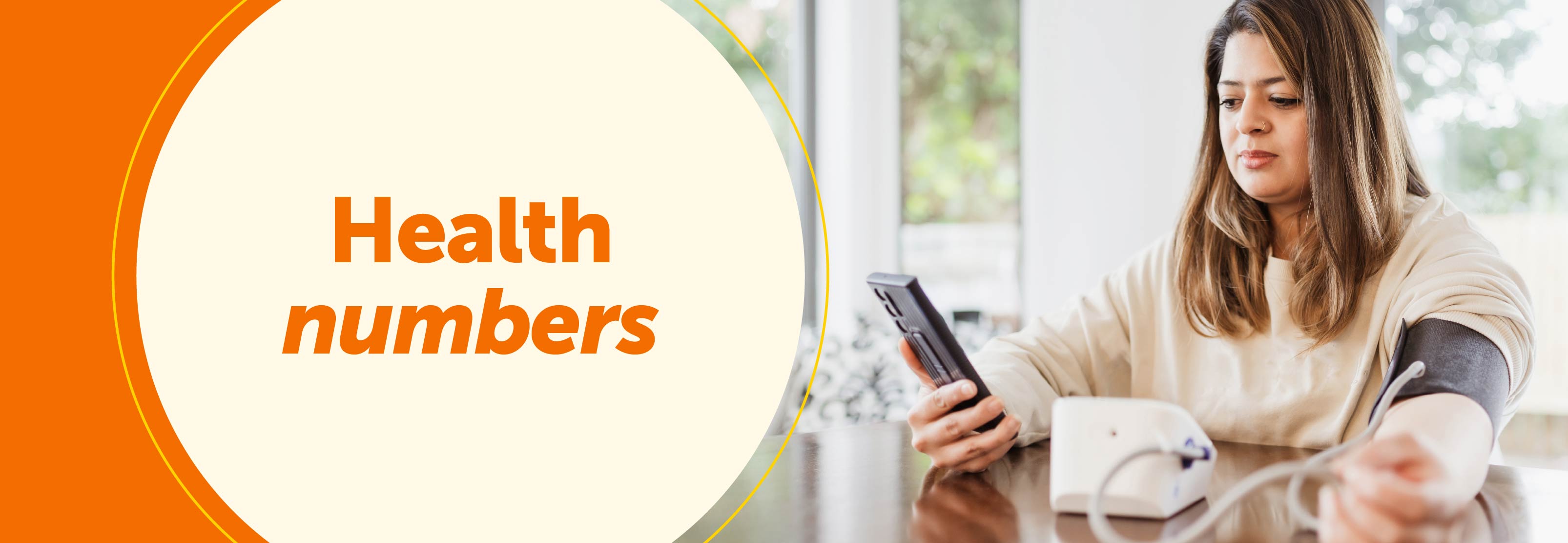
What do your health numbers mean?
Understanding your numbers like blood pressure, Body Mass Index (BMI), and cholesterol levels can help you understand your risk factors for certain diseases.
Learn more about what your health numbers may mean. All of the information presented below are general guidelines. They should not be used for self-diagnosis. Talk to your provider about your specific numbers.

Blood glucose is also called blood sugar. A blood glucose test is a blood test that tells you if your level of glucose, or blood sugar, is within a healthy range. It is a common test used to diagnose and keep track of diabetes or prediabetes.
Low Risk | Blood glucose |
|---|---|
Fasting (no food or liquids before test) | Less than 125 |
Non-fasting | Less than 200 |
Blood glucose levels listed are averages. Talk to your provider about what is right for you.
Source: WebMD

This is the pressure when the heart contracts and relaxes between beats.
Blood pressure measurements are given as two numbers. Systolic blood pressure is the upper number. Diastolic blood pressure is the lower number.*
Stage | Blood pressure |
|---|---|
Normal | Normal |
Normal | 120/80 or lower |
Elevated | 120-129/80 |
Stage 1 high blood pressure | 130-139/80-89 |
Stage 2 high blood pressure | 140/90 or higher |
Severe high blood pressure | 180/120 or higher |
Blood pressure levels listed are averages. Talk to your provider about what is right for you.
Get medical care right away if your blood pressure is much higher or lower than expected.
*Systolic blood pressure is the first (top/upper) number. It measures the pressure your blood is pushing against your artery walls when the heart beats.
Diastolic blood pressure is the second (bottom/lower) number. It measures the pressure your blood is pushing against your artery walls while the heart muscle rests between beats.
Learn how to get a blood pressure monitor with your health insurance. (PDF)
Source: American Heart Association (AHA)

Your Body Mass Index (BMI) tells you how much of your body is fat.
The higher your BMI, the higher your risk for certain diseases such as heart disease, high blood pressure, type 2 diabetes, gallstones, breathing problems, and certain cancers. Refer to the chart below for recommended healthy BMIs.
Category | BMI |
|---|---|
Underweight | Below 18.5 |
Healthy | 18.5-24.9 |
Overweight | 25.0-29.9 |
Obesity | 30.0 and above |
BMIs listed are averages. Talk to your provider about what is right for you.
Source: WebMD

This test measures the amount of cholesterol in your blood. This helps your provider know your risk for heart disease. Your body can have too much cholesterol if you eat the wrong types of foods like fried foods and foods with saturated or trans fats. Certain health conditions and family history can affect your cholesterol.
Here are general guidelines for healthy cholesterol:
Total cholesterol should be lower than 200mg/dl (or lower than 180 for people 30 years old)
LDL should be lower than 130mg/dl
HDL should be 35mg/dl or higher
Hemoglobin A1C levels listed are averages. Talk to your provider about what is right for you.
Source: WebMD

A1C is a blood test that shows average blood sugar (glucose) levels over the last 3 months. It can tell you if you have diabetes or prediabetes.
A1C results are reported as a percentage. Here’s what the results mean:
Category | A1C |
|---|---|
Normal | Below 5.7% |
Prediabetes | 5.7%-6.4% |
Diabetes | 6.5% or above |
Hemoglobin A1C levels listed are averages. Talk to your provider about what is right for you.
Source: WebMD