

Uncovering Barriers, Drivers, and Implications, and How It Shapes Healthcare Engagement
Trust in American healthcare is at its lowest level in decades.1, 2 Even in Illinois, where quality of care is an explicit priority within the Medicaid program,3 issues with trust affect preventive care and contribute to poorer health outcomes.4,5 Persistent disparities across racial and ethnic communities and low-income populations reinforce skepticism.6
For Meridian Health Plan of Illinois (Meridian), a Medicaid Managed Care Organization (MCO), addressing this issue is central to its mission of strengthening relationships with the communities it serves and addressing inequities while delivering care with dignity, respect, and cultural responsiveness.
To better understand how to overcome systemic distrust, Meridian launched an extensive quantitative study in late 2025. This builds on earlier qualitative research (including focus groups with community stakeholders, clergy, and Medicaid enrollees) to explore what trust means to Medicaid-eligible adults across Illinois.
Ultimately, friction determines whether intent leads to actual engagement in healthcare. The research reveals that many Medicaid enrollees hold conditional trust in their health plan — a baseline level of trust that can be quickly overridden by issues affecting healthcare decisions. Systemic and operational friction often prevent conditional trust from translating into action (such as scheduling a primary care visit for an annual wellness exam or completion of a cancer screening).
Meridian is committed to closing gaps in access and quality while supporting whole-person health so individuals and communities can thrive. The organization recognizes that addressing trust among Medicaid enrollees is a critical step to achieving these goals. The research translates enrollee experiences into clear insights on what drives trust, how friction can undermine it, and what actions can strengthen engagement.
Research Overview & Methodology
Meridian partnered with a minority-owned firm based in Chicago with deep multicultural expertise to design, conduct, and analyze the research. The survey was translated into five languages and fielded across eight culturally distinct communities statewide to ensure robust racial and ethnic representation. Sixty-six percent of respondents came from diverse communities, and 11% completed the survey in a language other than English.
The quantitative survey examined trust from multiple angles, including trust in the healthcare system and healthcare providers, confidence in various aspects of Medicaid plans, overall satisfaction with and likelihood of recommending Medicaid plans, and key moments that build or erode trust. These distinct yet interlinked factors — trust, confidence, and satisfaction — impact enrollee relationships with their health plans.
The study also examined healthcare engagement behaviors; structural, administrative, and emotional barriers to care; motivational drivers for preventive, vaccination, and mental health services; and differences by coverage context, race, ethnicity, and household characteristics.†
- Year and design: 2025 quantitative online survey designed to validate and deepen insights from earlier qualitative work
- Sample: n=698 Medicaid-eligible adults (18+) in Illinois; focused sample of n=350 Medicaid-enrolled respondents
- Racial/ethnic diversity: Hispanic/Latino 17%, Black/African American 13%, Ukrainian and other Eastern European 12%, Middle Eastern/MENA 12%, Indian Subcontinent 11.5%, Polish/Polish American 11%, White 11%, Chinese/Chinese American 11%
- Languages: Professionally translated English content into five languages (Spanish, Polish, Mandarin, Russian, and Arabic); 11% of respondents completed the survey in their preferred language
- Geography: Illinois residents within various zip codes across Illinois
- Comparison: Behavior and barriers analyzed by current coverage type (Medicaid-enrolled vs. employer-sponsored vs. individually purchased plans)
- Limitations: Findings reflect self-reported experiences rather than clinical outcomes
Research Findings
The research shows a positive baseline of trust in healthcare with clear room for growth.
Just 52% of Medicaid respondents in Illinois trust the healthcare system to treat people like them fairly. However, they have higher trust in their plans — 70% of Medicaid respondents reported being very or somewhat satisfied and 59% described their plan as “trustworthy.” At the same time, nearly one-quarter (23%) felt neutral, and sizable minorities described their plan as hard to reach (18%), confusing (18%), impersonal (15%), or inconvenient (12%).
Despite this baseline of trust, engagement in healthcare is inconsistent. The research shows that trust alone does not drive care. Friction, factors that affect when people seek healthcare, determines whether trust turns into action. The research reveals three key findings that illuminate the barriers that prevent engagement and how to address them.
Finding 1: Preventive Care Engagement Gaps May Occur When Access Barriers Override Trust
The data reflects conditional trust among Medicaid respondents, which does not always translate to proactively seeking care. Consistent preventive care engagement is often undermined by practical difficulties. This dynamic contrasts with lower-friction experiences of Medicaid-eligible respondents with employer-sponsored insurance.
Only 48% of Medicaid respondents reported seeking regular preventive care. Twenty-three percent visit only when they feel sick, 19% engage occasionally (every few years), and 11% rarely or never seek preventive care. This reactive pattern aligns with the finding that 61% said they only go to the doctor when something is wrong.

"I never call off work. If I'm not feeling well, I still go. I can't afford to take a day off. That's a day of pay I won't get back."
— Dominique (Medicaid Enrollee, qualitative survey respondent)
By comparison, Medicaid-eligible adults with employer-sponsored coverage show higher routine engagement (66% seek regular preventive care) and markedly lower friction. Transportation barriers affect about 48% of Medicaid respondents often or always (versus 25% employer-sponsored); confusing paperwork affects around 49% of Medicaid respondents (versus 43% employer-sponsored); forgetting or procrastination affect 55% (versus 49% employer-sponsored). Together, structural and administrative barriers compound the challenges that Medicaid respondents face in their daily lives. Other research confirms that individuals enrolled in Medicaid tend to be more disadvantaged than those who are eligible but opt for private insurance. Medicaid enrollees are more likely to have more severe health issues, fewer financial cushions, and higher social vulnerabilities — all of which show up in the barriers that limit regular preventive care. 7, 8
How should healthcare stakeholders address these barriers? When asked what would motivate them to seek preventive care in the survey, Medicaid respondents rated convenience and support-based resources (such as free rides and care coordinators) as most impactful.
The findings reinforce the importance of reducing friction to increase engagement for Medicaid enrollees, even when there is baseline trust.
Figure 1: Top Barriers to Preventive Care by Insurance Coverage
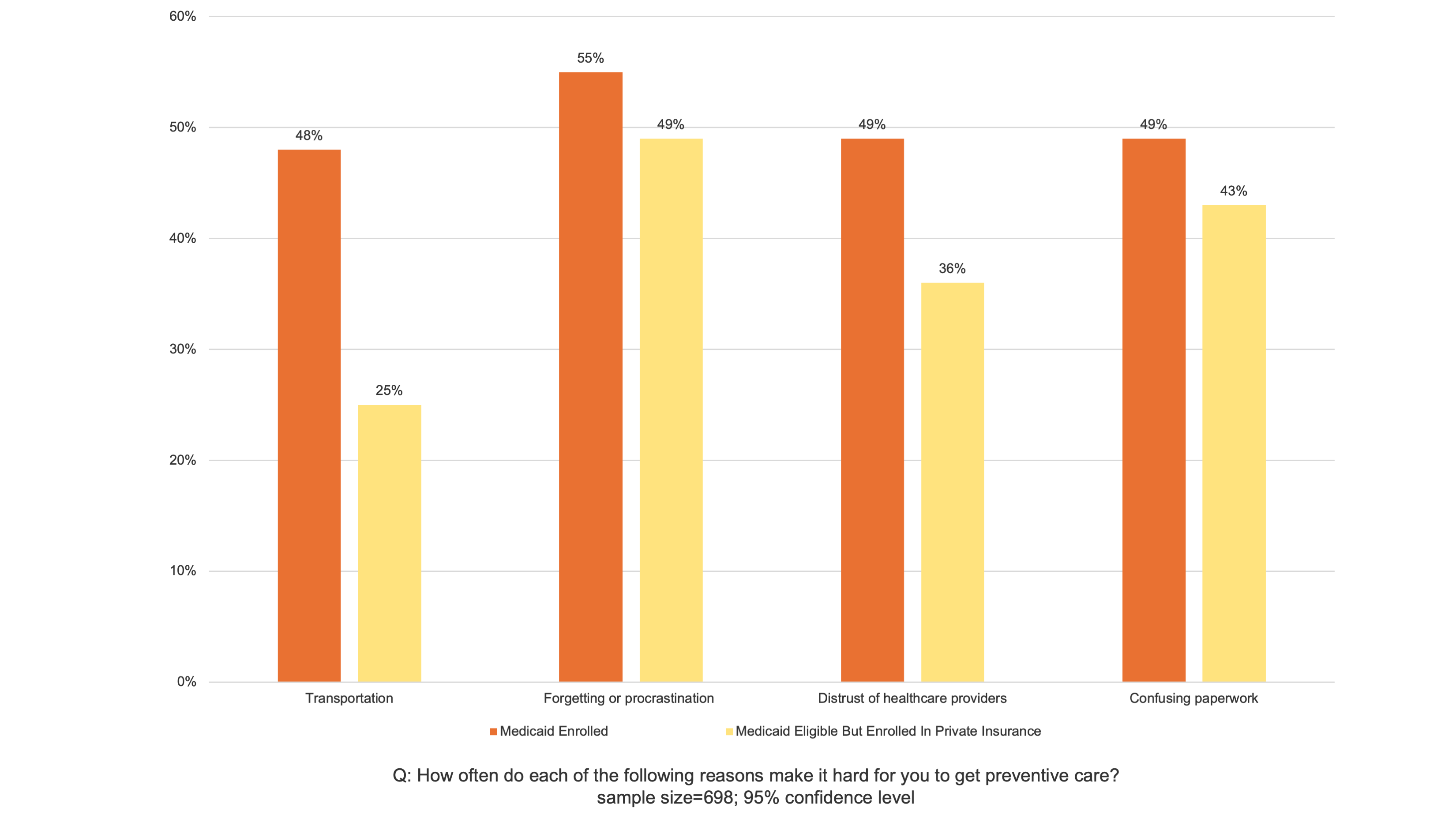
Key Insight: Medicaid respondents face a denser stack of barriers than Medicaid-eligible respondents. Addressing structural and administrative friction will help increase engagement in preventive care, while boosting trust in healthcare.
Finding 2: Barriers to Vaccination and Mental Health Differ — and So Should Strategies
Low engagement levels in high-priority services like vaccination and mental health are driven by a complex interplay of factors. Bridging the gap between coverage and care requires a strategy as diverse as the barriers Medicaid enrollees face.
For vaccination, behavior remains inconsistent. Only 32% of Medicaid respondents get vaccinated as often as recommended (versus 47% of Medicaid-eligible respondents with employer-sponsored coverage). Informational barriers are most prominent for Medicaid respondents, where 55% report fear of side effects and 40% cite confusion or too much information. Forty percent report distrust of healthcare providers.
For mental health services, engagement levels among Medicaid respondents are comparable to those with other coverage types. Eighteen percent reported using services regularly (versus 14% of respondents with employer-sponsored coverage), while 35% rarely or never access care (versus 31% of respondents with employer-sponsored coverage). Relational challenges are among the most frequently cited barriers for Medicaid respondents, including difficulty finding a provider who “gets you” (55%), distrust of mental health providers (56%), and cultural stigma (41%). ‡

"We're navigating misinformation or trying to decipher what's fake news versus what's backed by science and research."
— Michelle (Community Leader, qualitative survey respondent)
These variances underscore the need for differentiated strategies rather than a one-size-fits-all approach.
Figure 2: Trust Barriers Differ by Type of Health Service
Type of Health Service | Top Barriers | Implications for Healthcare Stakeholders |
|---|---|---|
Preventive Care | Forgetting or procrastination: 55% |
|
Vaccination | Fear of side effects: 55% |
|
Mental Health | Distrust of mental health providers: 56% |
|
Key Insight: Preventive care requires structural and administrative support. Vaccination requires informational clarity; mental health requires relational trust.
Healthcare stakeholders should consider differentiated but complementary strategies to address these barriers and increase trust — not a one-size-fits-all approach.
Finding 3: Culturally Competent Care and Understanding as a Critical Opportunity
The survey findings reinforce culturally competent care as an opportunity to build deeper trust with Medicaid enrollees. When asked how confident they were that their health plan would deliver on a variety of dimensions, Medicaid respondents gave the highest marks to data protection and reliability (63%), followed by accurate information and support (59%). However, only 51% reported that their health plan understands their culture and community background — the lowest-rated dimension tested.
Figure 3: Confidence Varies Across Different Dimensions of Healthcare Plans
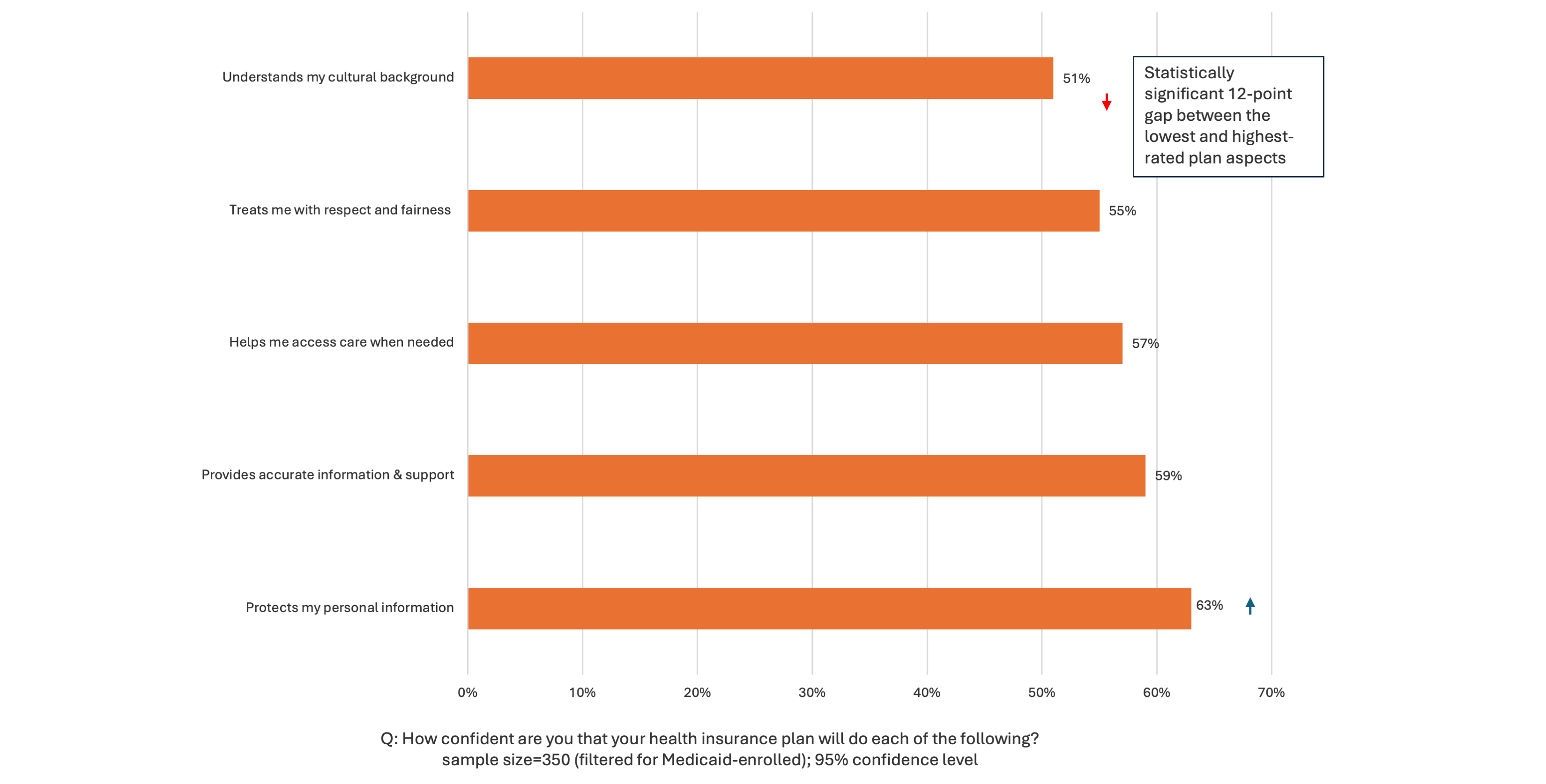
Key Insight: Cultural understanding is the most fragile dimension of confidence in health plans of those tested. Closing this gap and demonstrating deep cultural understanding of enrollees’ lived experiences will increase trust.
A clear personal-versus-system trust gap is also evident. Sixty-eight percent of Medicaid respondents say they feel comfortable speaking to doctors or healthcare staff about their needs. Yet only 52% agree that the healthcare system treats people like them fairly.
Perceptions vary meaningfully by race and ethnicity. Diverse communities and especially Middle Eastern/MENA respondents report low agreement that the system treats people fairly, while White respondents report the highest. Similarly, Hispanic/Latino and Indian Subcontinent respondents show the lowest confidence that their doctor or health plan understands their culture.

“When the doctor tries to speak Spanish, even if it isn’t perfect, it’s a sign of respect, that he cares about me.”
— Adriana (Medicaid Enrollee, qualitative survey respondent)
Figure 4: Trust Gaps by Racial/Ethnic Community
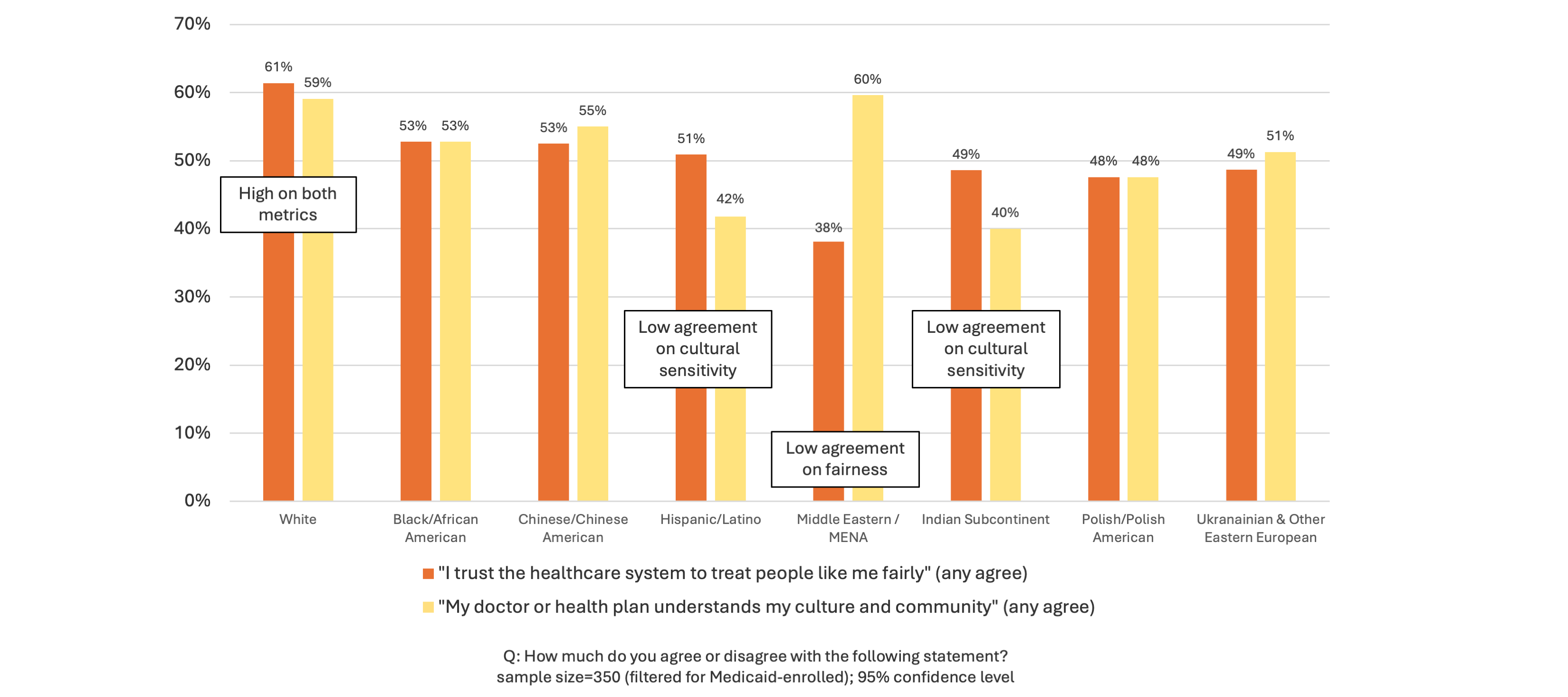
Key Insight: Confidence in fairness and cultural sensitivity varies meaningfully across Medicaid respondents in Illinois. Strategies must be community-specific, using personalized and culturally relevant messaging that goes beyond standard translation to reflect transculturation — how meaning, trust, and expectations evolve through lived experience.
Other research confirms the value of culturally competent care, which involves frontline providers and healthcare organizations adapting their services to deliver high-quality, respectful care to diverse communities. Structural interventions that embed cultural sensitivity into policies, language access, and benefits have been shown to improve outcomes by building institutional trust and compliance.9, 10
Collectively, these findings suggest culturally relevant care goes beyond the exam room and is critical to improving trust across the healthcare system.
Research Implications: Ways to Improve Access and Earn Trust
When asked to select words to describe their ideal experience, Medicaid respondents said healthcare should be “affordable,” “understanding,” and “easy.” These preferences reinforce the need to reduce friction that makes care difficult to access, while also demonstrating that the healthcare system understands enrollees and their unique needs.
The research demonstrates that even when some trust is present, healthcare stakeholders can do more to reduce friction, provide clarity, and demonstrate cultural understanding. Needs differ by care type (preventive care, vaccination, mental health) and across racial and ethnic communities. An across-the-board approach will not work. Solutions must recognize where Medicaid enrollees are in their care journey, and respond with relevant, friction-reducing solutions.
Meridian has several initiatives underway that align with the friction points highlighted in the research. The research offers added perspective on where existing efforts are relevant and where continued focus, refinement, or new approaches may be needed to better support members’ access to care.
1. Reducing Friction to Close the Trust-Behavior Gap in Preventive Care
To directly address structural and administrative barriers, Meridian is streamlining prior authorization procedures. Simplifying these processes minimizes administrative complexity, reduces delays, and allows providers to focus more on patient care — ultimately creating a more seamless and responsive healthcare experience.
When it comes to Medicaid transportation benefits, Meridian has dedicated staff who actively monitor transportation challenges — including longer-distance trips — and help members find more accessible providers to reduce the downstream impact of transportation barriers (such as missed appointments and readmissions). In addition, Meridian provides personalized digital communication journeys in English and Spanish that guide members step-by-step to the information they need to access care, benefits, and support.
In an effort to reduce barriers to maternal care, the Meridian MomCare program serves as a one-stop resource for essential care and personalized support. MomCare provides 1:1 support through a dedicated advocate during pregnancy and postpartum. Community partnerships extend access, including The Link & Option Center, Inc., a local doula provider in South Chicago serving a large Black/African American population, a mobile pregnancy and postpartum care unit with OSF Healthcare in Central Illinois obstetric care deserts, and ongoing collaboration with the March of Dimes to deliver maternal health information and resources directly to Chicagoland families. A new partnership with Pomelo, a 24/7 virtual medical provider, has also engaged hundreds of pregnant Meridian members in its initial months by addressing key risk factors affecting maternal and infant health.
2. Distinct Strategies for Building Trust in Vaccination and Mental Health
Meridian delivers hyper-personalized preventive care journeys, which include vaccination education and community outreach to counter informational barriers. To address relational barriers, behavioral health integration includes care manager support, provider training, telehealth, and virtual care options. For example, a peer support initiative that leverages Meridian employees with lived experience to provide individualized guidance and peer-to-peer relationships.
Complementing this work, Meridian’s foster care health plan, YouthCare HealthChoice Illinois, is sponsoring the nationally recognized Training for Adoption Competency program to strengthen clinicians’ ability to address the behavioral and developmental health needs of children in foster, adoptive, and kinship families.
3. Advancing Cultural Relevance and Understanding
Meridian is translating research insights into provider training and cultural competency materials across its network. The Care in Our Community initiative delivers programs in members’ own neighborhoods, honoring local and cultural roots. A new partnership with Violet, a cultural competence analytics and provider training platform, is designed to improve health outcomes, reduce total cost of care, and expand access to person-centered care for rural and diverse populations across the state.
To address other disadvantages Medicaid enrollees face and social drivers of health linked to structural friction, Meridian’s Eat Well, Be Well nutrition initiatives help tackle food insecurity while providing culturally relevant wellness resources. Examples include the Food is Medicine partnership with the Greater Chicago Food Depository, which offers medically tailored meals that honor cultural preferences, and the Meridian at the Market program, which offers farmers’ market vouchers for fresh produce. Meridian also offers culturally relevant education, including recipes for a variety of health conditions and dietary needs.
Looking Ahead
Trust fosters better communication, engagement, and health outcomes. Yet it is built slowly through consistent, visible action. For Medicaid enrollees, trust hinges on whether health plans reliably reduce friction and show up when needed.

“Building trust is everything. When our members know we’re here for them, it changes their health — and their lives.”
— Jeni (Care Coordinator)
The path forward requires shared responsibility. MCOs, providers, and communities must collaborate on barrier-reducing solutions and culturally resonant care. Meridian remains committed to these efforts as a trusted partner in advancing whole-person health for Illinois Medicaid enrollees.
About Meridian Health Plan of Illinois
Meridian Health Plan of Illinois, Inc. and its family of health plans provide government-sponsored managed care to families, children, seniors, and individuals with complex medical needs. This includes Meridian’s Medicaid Plan, YouthCare HealthChoice Illinois, Wellcare (Medicare Advantage plans), Wellcare By Meridian (Dual-Eligible Special Needs Plan), and Ambetter Marketplace plans. Meridian connects members to care and offers comprehensive services to support lifelong health and wellness. Meridian is a company of Centene Corporation, a leading healthcare enterprise committed to helping people live healthier lives.
Notes
† We provide descriptive statistics rather than causal analysis. The sampling design carefully balanced sample size and the acceptable margin of error to guarantee sufficient statistical power, ensuring our final results achieved statistical significance.
‡ We did not ask about mental health diagnoses in the survey. We consequently cannot determine if the rate of engagement in mental health services matches the rate of mental health diagnoses.
References
1. eHealth. (2025, March). 2025 Healthcare pulse survey: eHealth original research. https://news.ehealthinsurance.com/_ir/68/20251/Healthcare_Pulse_Survey_2025.pdf (PDF)
2. Adams, K. (2025, May 8). Americans’ trust in the healthcare system is plummeting. How can it be repaired? MedCity News. https://medcitynews.com/2025/05/healthcare-trust/.
3. Illinois Department of Healthcare and Family Services. (2024). 2024–2027 comprehensive medical programs quality strategy. https://hfs.illinois.gov/content/dam/soi/en/web/hfs/sitecollectiondocuments/il20242027qs.pdf (PDF)
4. Darden, M. E., & Macis, M. (2024, January). Trust and health care-seeking behavior (NBER Working Paper No. 32028). National Bureau of Economic Research. https://doi.org/10.3386/w32028
5. Edelman Trust Institute. (2022, March 10). 2022 Edelman Trust Barometer special report: Trust and health. 2022 Edelman Trust Barometer Special Report: Trust and Health. https://www.edelman.com/sites/g/files/aatuss191/files/2022-03/2022%20Trust%20Barometer%20Special%20Report%20Trust%20and%20Health_Mar10.pdf (PDF)
6. Harvard T.H. Chan School of Public Health. (2023, February 7). Marginalized communities likely to distrust healthcare system, polling finds. https://hsph.harvard.edu/news/marginalized-communities-likely-to-distrust-healthcare-system-polling-finds/
7. Garrett, B., Abdus, S., Banthin, J., & Selden, T. (2023, August). Medicaid-eligible adults who lack private coverage and are not enrolled: Are they uninsured? Urban Institute. https://www.urban.org/sites/default/files/2023-08/Medicaid-Eligible%20Adults%20Who%20Lack%20Private%20Coverage%20and%20Are%20Not%20Enrolled.pdf (PDF)
8. Davidoff, A., Garrett, B., & Yemane, A. (2001, October). Medicaid-eligible adults who are not enrolled: Who are they and do they get the care they need? (New Federalism: Issues and Options for States, Series A, No. A-48). Urban Institute. https://www.urban.org/sites/default/files/publication/61421/310378-Medicaid-Eligible-Adults-Who-Are-Not-Enrolled.PDF (PDF)
9. Saha S, Beach MC, Cooper LA. (2008). Patient centeredness, cultural competence and healthcare quality. Journal of the National Medical Association 100(11), 1275-85. https://doi.org/10.1016/s0027-9684(15)31505-4
10. Brach C, Fraser I. (2002). Reducing disparities through culturally competent health care: An analysis of the business case. Quality Management in Health Care, 10(4), 15-28. https://doi.org/10.1097/00019514-200210040-00005